What makes a great team?
For years, organizations searched for the perfect formula. Some believed success depended on hiring the smartest people. Others focused on experience, technical expertise, or personality traits. Businesses invested heavily in recruiting top talent, assuming that assembling a group of exceptional individuals would naturally lead to exceptional performance.
Yet many teams filled with highly skilled professionals still struggled to collaborate effectively.
One of the most influential workplace studies of the modern era challenged these assumptions. Google’s Project Aristotle sought to answer a simple but important question: Why do some teams consistently outperform others?
The findings transformed how many organizations think about teamwork, leadership, and workplace culture. Rather than identifying intelligence or experience as the defining factor, the research highlighted something far more human: psychological safety.
Today, psychological safety is widely recognized as one of the foundations of high-performing teams and a key element of the future of work.
What Is Psychological Safety?
Psychological safety refers to a workplace environment where employees feel comfortable expressing ideas, asking questions, admitting mistakes, and sharing concerns without fear of embarrassment, punishment, or unfair criticism.
It does not mean avoiding accountability or lowering performance expectations.
Instead, psychological safety creates conditions where people can contribute openly because they trust that their opinions will be heard respectfully.
In psychologically safe teams, employees are more likely to:
- Share new ideas
- Ask for help when needed
- Offer constructive feedback
- Admit mistakes early
- Challenge assumptions respectfully
- Participate in discussions without hesitation
The result is stronger collaboration and better decision-making.
The Question Behind Project Aristotle
Google has long relied on data to improve products and business operations. The company applied that same analytical mindset to understanding team performance.
Project Aristotle was launched to explore why certain teams consistently achieved better results than others.
Researchers examined numerous factors, including:
- Individual talent
- Educational backgrounds
- Technical skills
- Personality traits
- Team structures
- Management styles
- Communication patterns
Many expected the highest-performing teams to consist of the most experienced or technically capable employees.
Instead, the research pointed in another direction.
The way people interacted with one another mattered more than individual credentials alone.
The Five Characteristics of Effective Teams
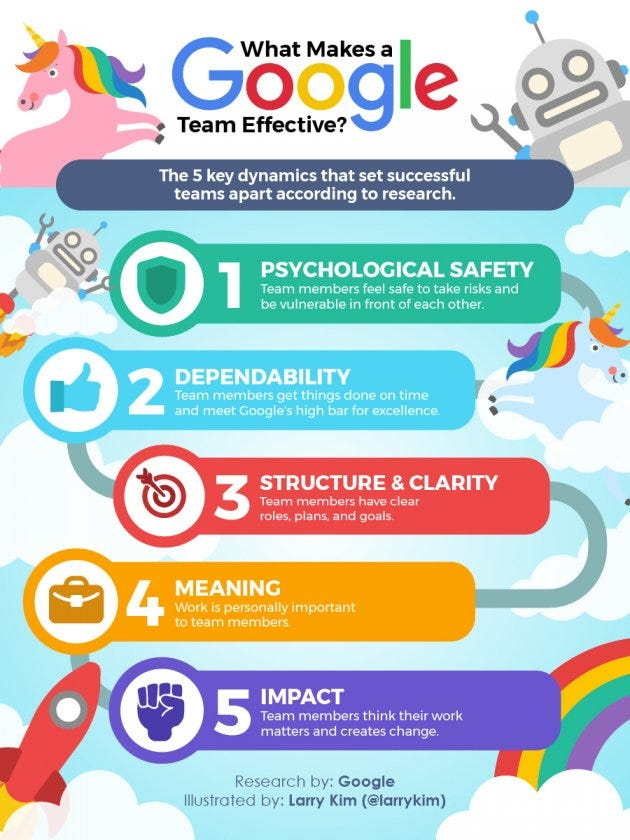
Project Aristotle identified several characteristics commonly found in successful teams.
Among them were:
- Psychological safety
- Dependability
- Structure and clarity
- Meaning in work
- Sense of impact
While each factor contributed to team effectiveness, psychological safety emerged as the strongest foundation.
Without trust, the other characteristics became much harder to develop.
Employees who fear speaking up are less likely to collaborate, solve problems creatively, or identify risks before they become larger issues.
Why Psychological Safety Drives Performance
At first glance, creating a comfortable environment may seem unrelated to business performance.
In reality, psychological safety improves many aspects of teamwork.
Better Communication
When employees feel safe expressing their thoughts, conversations become more honest and productive.
Rather than remaining silent, team members are more likely to:
- Share concerns early
- Clarify misunderstandings
- Offer new perspectives
- Ask important questions
Clear communication reduces confusion and helps teams solve problems faster.
Stronger Innovation
Innovation depends on experimentation.
New ideas often begin as unfinished concepts that require discussion and refinement.
If employees worry about being judged for imperfect ideas, they may choose not to share them.
Psychological safety creates an environment where creativity can flourish because people feel comfortable contributing without fear of unnecessary criticism.
Faster Learning
Every organization makes mistakes.
The difference lies in how teams respond.
Psychologically safe workplaces encourage employees to acknowledge errors quickly, learn from them, and improve future processes.
Rather than hiding problems, employees work together to solve them.
This creates a culture of continuous learning instead of blame.
Trust Is the Foundation of High-Performing Teams
Trust is closely connected to psychological safety.
Employees who trust one another are more willing to:
- Collaborate openly
- Share knowledge
- Support colleagues
- Accept feedback
- Work toward shared goals
Trust allows teams to focus their energy on solving business challenges rather than protecting themselves from criticism.
Building trust takes time, consistency, and leadership that demonstrates integrity and respect.
Inclusion Strengthens Team Performance
Psychological safety also supports inclusion.
Employees bring different backgrounds, experiences, and perspectives to the workplace.
Organizations benefit when everyone feels encouraged to participate.
Inclusive teams are more likely to:
- Consider multiple viewpoints
- Identify creative solutions
- Improve decision-making
- Understand diverse customer needs
Inclusion is not simply about representation.
It is about ensuring every employee has the opportunity to contribute meaningfully.
Psychological safety helps make that possible.
Leadership’s Role in Creating Psychological Safety
Leaders have a significant influence on whether employees feel comfortable speaking openly.
Supportive leadership encourages participation through everyday actions rather than occasional initiatives.
Listening Before Responding
Employees are more likely to contribute when leaders genuinely listen to their ideas.
Active listening demonstrates respect and encourages continued participation.
Rather than immediately providing answers, effective leaders ask thoughtful questions and invite discussion.
Encouraging Questions
Curiosity should be viewed as a strength rather than a weakness.
Leaders who welcome questions create environments where learning becomes part of everyday work.
Employees become more confident seeking clarification and sharing knowledge.
Responding Constructively to Mistakes
Mistakes should be addressed appropriately, but they also create opportunities for learning.
Leaders who respond constructively encourage employees to report issues early rather than hiding them.
This allows organizations to solve problems before they become more significant.
Technology Cannot Replace Trust

Modern workplaces rely heavily on digital collaboration tools.
Video meetings, messaging platforms, project management software, and artificial intelligence have transformed how teams communicate.
However, technology alone cannot create psychological safety.
Digital tools can improve communication, but trust depends on human behavior.
Organizations should use technology to:
- Make collaboration easier
- Improve transparency
- Support knowledge sharing
- Reduce communication barriers
The culture surrounding these tools determines whether employees feel safe using them openly.
Practical Ways to Build Psychological Safety
Organizations do not need major structural changes to strengthen psychological safety.
Small, consistent actions can have a meaningful impact.
Encourage Open Dialogue
Create regular opportunities for employees to share ideas and concerns.
Team discussions should invite participation rather than simply communicate decisions.
Normalize Feedback
Constructive feedback should be viewed as an opportunity for improvement.
Both managers and employees should feel comfortable giving and receiving respectful feedback.
Celebrate Learning
Recognize not only successful outcomes but also thoughtful experimentation and continuous improvement.
Learning cultures encourage growth rather than perfection.
Respect Different Perspectives
Healthy disagreement often leads to better decisions.
Encouraging respectful discussion allows teams to evaluate ideas more thoroughly while strengthening collaboration.
Why Psychological Safety Matters in the Future of Work
As workplaces become more digital, flexible, and globally connected, collaboration is becoming increasingly important.
Organizations are relying on teams that work across locations, cultures, and time zones.
In these environments, psychological safety becomes even more valuable.
Employees who trust one another can collaborate more effectively despite physical distance.
Human-centered workplaces increasingly recognize that sustainable performance depends not only on technical expertise but also on communication, empathy, and shared purpose.
The future of work will require organizations to build cultures where employees feel empowered to contribute fully.
The Lasting Impact of Project Aristotle
Project Aristotle changed the conversation about workplace success by demonstrating that exceptional teams are not simply collections of exceptional individuals.
They are environments where people trust one another, communicate openly, and feel safe bringing their full perspectives to the table.
The research encouraged businesses to move beyond traditional assumptions about performance and focus instead on the quality of relationships within teams.
Today, psychological safety has become one of the defining principles of modern leadership and organizational culture.
Building Teams Where People Thrive
The most successful workplaces are not those where employees never make mistakes or always agree. They are workplaces where people can ask questions, challenge ideas respectfully, admit when they need help, and learn together.
Google’s Project Aristotle demonstrated that trust, inclusion, and safe communication are not simply cultural ideals—they are practical drivers of innovation, collaboration, and long-term business success.
As organizations continue shaping the future of work, psychological safety will remain one of the most important investments they can make. By creating environments where every employee feels heard, respected, and empowered to contribute, businesses build stronger teams that are prepared to adapt, innovate, and grow together.